Like much of the world, the South of France has been experiencing an unusually hot summer. A few weeks ago when we hit a particularly hot stretch, I started looking around for a place where I could break the cycle for a few days. At heart, I’m a mountain girl (montagnarde in French), and when some friends recommended Andorra, I jumped. It offers stunning mountains, high elevations, dry air and my favorite: a high barometric reading. So I threw a bag in the car and drove to the hills for an Andorra altitude adjustment.
How did I get here?
It was a few hours’ drive from home to fresh mountain air, the road steadily climbing and curving its way upward. When I came around a bend and saw the view above, it seemed a good opportunity to take in a deep breath of alpine air, stretch my legs, and make an attempt at capturing the grandeur of the Pyrenees.
One thing I hadn’t seen in a long time was snow stakes in their orderly march along both sides of a highway.
The official language of Andorra is Catalan, and I had fun with the words and the signage. This says “Welcome to Canillo,” which is the parish where I was staying.
When I was a kid, we took family road trips in the summer, and one of our favorite road-trip pasttimes was the license plate game. This was the United States, so we were trying to spot a plate from each of the 50 states. The big prizes were Hawai’i, Alaska and Rhode Island, and now I’m thinking that Andorra fits on some list of hard-to-find license plates.
Heading down the mountain from my hotel, the route hugged steep terrain on its way to the capital city of Andorra, named Andorra La Vella. Another parish in the country is Escaldes-Engordany, which I think is fun to say.
What did I find?
This trip was a bit of a last-minute decision, and the only thing on my mind was finding cooler weather. I didn’t know much about Andorra, except that people sometimes go there for duty-free shopping, and it’s a regional skiing mecca.
What I found was stunningly beautiful mountains, flowing rivers, and some of the kindest people I’ve met in my travels. I also found some great Romanesque structures, mostly churches. Read on to see more!
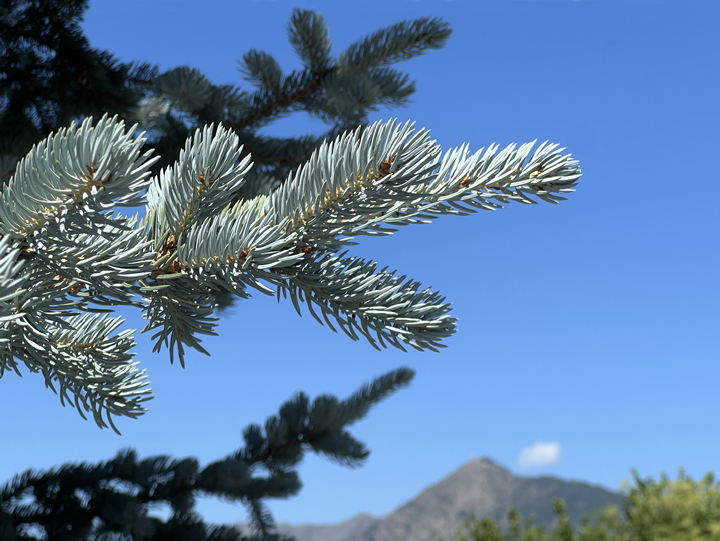
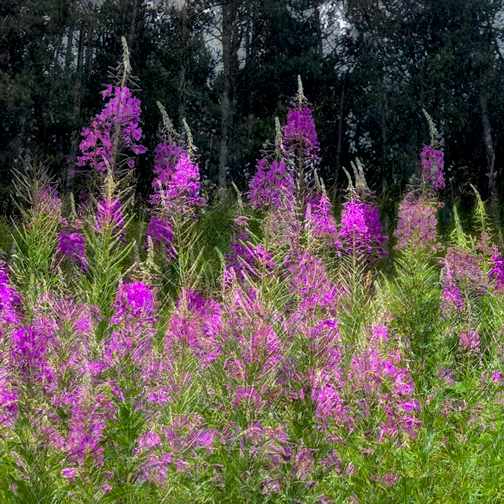
Little reminders of Colorado: here’s a photograph of fireweed, which lined many of the roads in Andorra. The opening photo is a blue spruce, native to the western United States.
This is the lovely Puente de Sant Antoni de la Grella, which is not technically medieval, but follows Romanesque design principles. Found in La Massana, it crosses the Valira del Nord River.
Riu Valira del Nord.
From the stone village of Pal, a lovely view of the mountains.
A roof made of lauzes, hand-cut slate tiles in a fish-scale design. These roofs look nearly identical to those we saw in the Aubrac region of France when walking the Chemin de Compostelle. The wood poles help prevent a heavy snow load from sliding right off the roof and onto an unsuspecting head.
Another day, another bridge. This is the 14th-century Puente de La Margineda, on the outskirts of the capital city of Andorra la Vella. It crosses the Gran Valira River.
Campanula blooming on the trail that runs alongside the Riu Gran Valira.
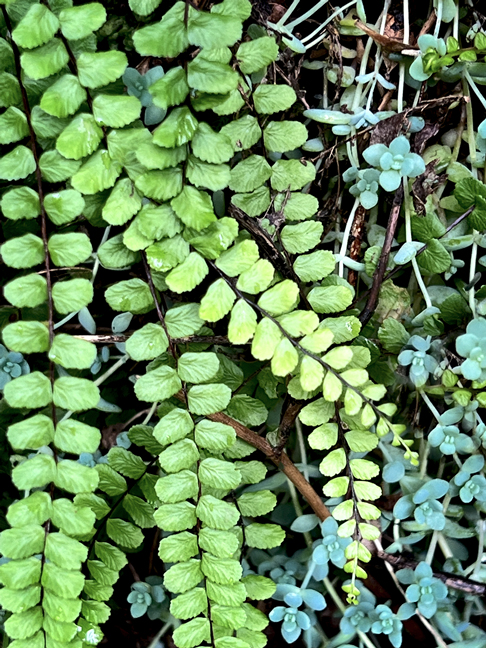
Shades of green on a rainy afternoon walk.
Romanesque art and architecture
I’ve never really been able to explain it, but I feel quite drawn to early medieval art and architecture, specifically, the time frame roughly between the 8th through early 12th centuries. This includes the period that is often referred to as Romanesque (11th-early 12th centuries).
The trip to Andorra helped me to clarify a little about why I like it. First, it’s important to note that most of what remains from this period is related to Christianity: various forms of churches and the art they contained. I’m not Christian, so it’s not a religious attraction, and I think that part of my interest lies in the rarity of the examples.
But there’s much beyond that. The architecture can appear blunt and bulky and uninteresting, because the churches tend to be weighty and undecorated. But the decorations that exist are often exquisite: carved column capitals showing Biblical scenes, motifs from nature, and animals. The Kilpeck Church (c. 1140) in Herefordshire, England, has its original carvings, including animals, monsters and a dog that looks like a 1960s-era cartoon character. I like that early medieval art often depicts real life, even the scary or mysterious bits, even in a church.
Another thing that intrigues me about Romanesque art is how the religious message was interwoven with myth and magic. All senses were engaged, especially the heart. Attending church was an experience of feeling and emotion, a different experience than the more intellectual style that arrived later with the Gothic period and really took hold during the Renaissance.
We can only imagine today what a visit to one of these churches would have been like a thousand years ago, when vivid color covered every surface, censers waved smoky incense, sculpture and art were everywhere, and there were stories of the beasts and monsters that awaited those who were destined for hell. The church would have been the absolute center of life in a village, and I think it’s not a stretch to imagine that a little entertainment was part of the package.
Sant Climent de Pal, 11th-12th centures. The Romanesque churches in Andorra are built of stone, and most have been augmented over the centuries. What haven’t changed much are the Lombard bell towers, which were built later in the 12th century by itinerant Italian architects who traveled the length of the Pyrenees. This tower is unique, because while all the Lombard towers have the distinctive double windows and banded decoration above the windows, the top level of the Sant Climent tower has double-double windows, two pairs of two. The small square holes were used in construction, for supporting the scaffolding needed to build the tower.
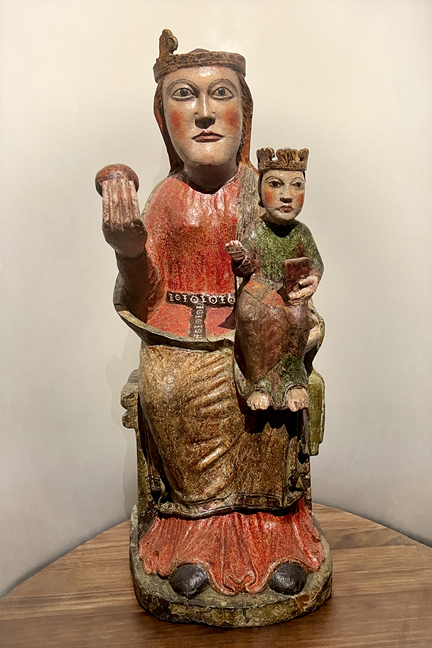
Our Lady of the Good Remedy is a figure found throughout the Pyrenees. The one from Sant Climent dates to the 12th century. While it has been restored, it was also already in unusually good condition because the townspeople knew they had a valuable treasure, one that could be stolen, and therefore it was kept well-hidden most of the time.
San Joan de Caselles holds a unique piece of religious art: a combination fresco and sculpture, likely created in place by two or more different artists. It dates to the 12th century, but had largely disappeared until a chance discovery in the 1960s. The fresco is intended to show the moments immediately before and after Christ’s death: to Christ’s right (the viewer’s left) is Longinus, who finally killed Christ and was converted; he is illuminated by the sun. To Christ’s left, under the moon, is Stefanus, the soldier who gave Christ a vinegar-soaked sponge and represents the damned. In the center of course is Jesus, an unusual sculpture made of stucco, plaster and animal glue, 175 cm tall (69 inches). During a 1963 restoration of the altar, a wooden plaque was found, and beneath it were the remains of this sculpture, broken into pieces. Shortly after, the whitewash on the wall was removed to reveal the fresco, and from there, the sculptural fragments could be restored to their intended place. It is magnificent.
Perched high in the mountains above the city of Les Escaldes is Sant Miquel d’Engolasters, a very small church with a very tall Lombard tower. It’s quite a peaceful spot.
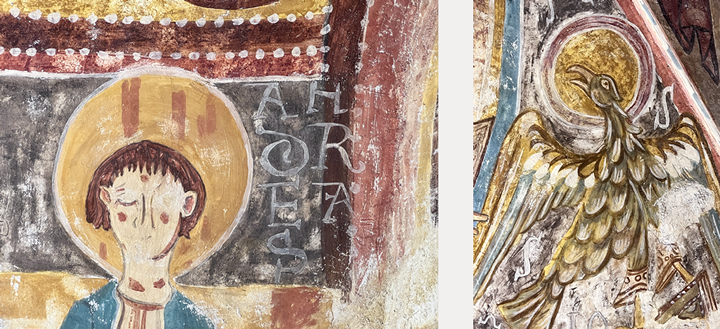
Two details of the paintings inside Sant Miquel, done in 1160 by the group known collectively as the Santa Coloma Master. This is a reproduction; the originals were removed in 1916, and are on display in the Catalonia National Art Museum. Seen at left is Saint Andrew, the only one whose name remains for identification (“Andreas”). In the close-up of Andrew, you can easily see the design element of rows of white dots, to be found in many of the paintings I saw in Andorra. They remind me of the dot patterns found in Australian Aboriginal painting. At right is Saint John, represented by an eagle.
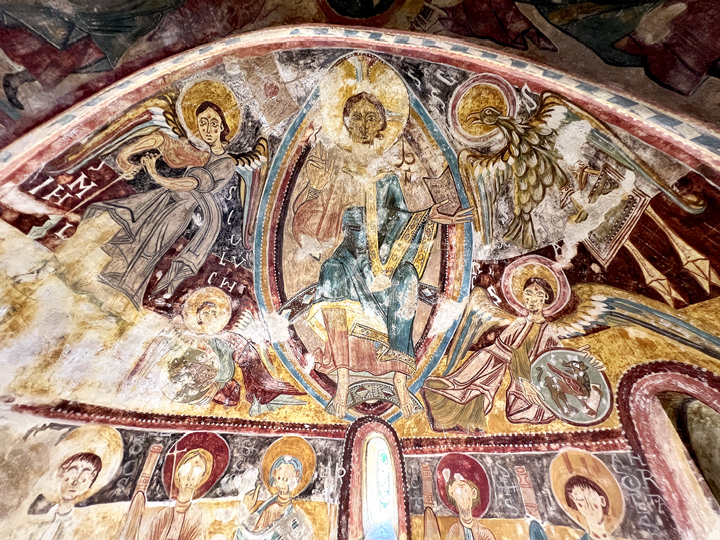
The glorious full painting in the apse of Sant Miquel d’Engolasters.
Santa Coloma, in the outskirts of Andorra la Vella. The church was originally built during the 8th-9th centuries, restored in the 12th. The 12th-century Lombard tower is circular, the only one of its kind in Andorra. There are traces of pigment inside the tower, supporting the idea that all surfaces inside both the church and the tower were likely covered with colorful paintings and decoration.
The walls of Santa Coloma were covered with colorful paintings of biblical scenes and embellished with geometric motifs. Very little remains, but there’s enough to piece together what the some of the originals probably looked like. This church has a barrel-vaulted apse that used to have exquisite paintings. They were removed and sold in 1933; the Andorran government managed to purchase them back in 2007, but they were too damaged to be returned to their original position. Most are on display in the nearby museum, Espai Columba. The paintings on the outer wall of the arch are the originals; in the center is the Agnus Dei, held by two angels. What you see above is a still from the excellent slide projection that “completes” the paintings so that you can sit in a pew and see what this church might have looked like 800 years ago. The arch is in a horseshoe shape that is usually attributed to a Moorish or Arabic influence, which is what I used to think. But I was corrected; in Andorra, this form is attributed to the Visigoths who ruled the Iberian Peninsula and part of southern France before the Moors arrived.
What the Santa Coloma arch and apse look like without the projection shown above.
References
Each of the churches I visited had at least one multilingual person there to welcome visitors and to talk about the art and architecture, the significance of the place, and a little bit about the general history of the region. This was a remarkably friendly, enthusiastic and knowledgeable group of people, easy to engage in conversation, very helpful.
Romanesque in Andorra, by Mireia Garcia, 2011 (English-language edition). This lovely little book is packed full of general historical information along with the Andorra-specific entries for all of the Romanesque structures to be found there. It even includes information about finding the locations and parking.
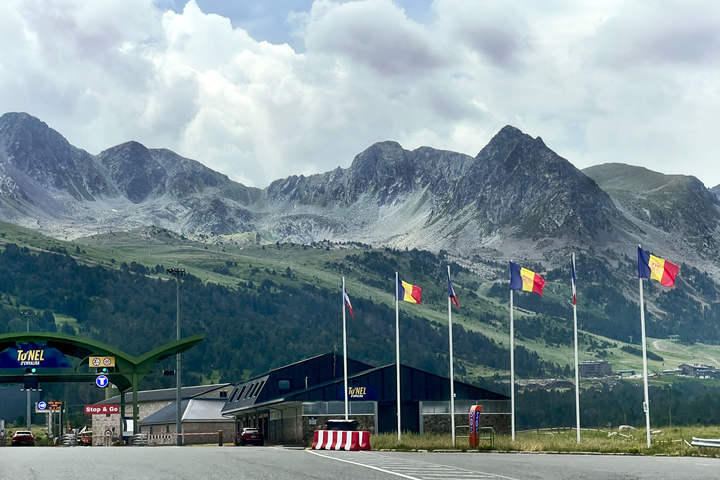
The Andorran flags whip in the stiff breeze as I approach the remarkable bit of engineering known as the Túnel d’Envalira, a three-kilometer tunnel.
Heading home
After my brief three-day getaway in search of cooler weather, it was time to head back home. The friendly staff at my hotel sent me off with sweet heartfelt good-byes and promises to see each other again soon, and then I turned my car uphill toward the French border…
Where there was a long line of cars waiting.
Not a bad spot if you have to sit in your car while the long line of traffic comes to a virtual stop. A cute Mustang in front of me, a strong cyclist to my left, and dominating everything, a majestic selection of craggy Pyrenees mountains.
A snapshot of the Pyrénées-Orientales region of southwestern France. I was turning left toward Perpignan, and then home. Along the way, I passed plenty of places to come back and explore: caves with prehistoric art, two fortifications built by the great 17th-century military architect Vauban, several early-medieval abbeys, hiking amongst stunning rock formations, and more, all under the watchful eye of Mont Canigou, the tallest peak in the eastern Pyrenees.
Parting shot
I was exploring the excellent little museum Espai Columba, which is just across the street from the Santa Coloma church, when I spotted this vivid remnant of medieval painting. All I could think of was “Talk to the hand.”












 Lo Vedo Life