During their married life, my parents lived in two houses, and in each of them the garage was my father’s man cave. It was where he went to tinker, which he was remarkably good at. He solved many a household problem, even when the rest of us weren’t aware there was a problem. He’d go out to the garage and sketch one or two possible solutions, and then spend a great deal of time crafting this or that object, using whatever he could find to make the perfect gizmo.
While Dad was a good problem-solver and creative thinker, he was not the most organized guy on the block. Added to that, he was a child of the Depression, and like a great many Americans of that era, Dad simply could not bring himself to discard anything that might one day in the future have a remote possibility of being the tiniest bit useful. Bits of wire, a mind-boggling array of wrenches and hex keys, a great many items that had been torn, broken or moth-eaten, long-empty bottles of various garage-oriented fluids: he had in mind that someday, any one of these items could be the exact thing he would need to make a repair or to create something wholly new. He also had a pretty good idea of where everything was and could find what he needed almost immediately, even if he hadn’t laid eyes on it in years. Nowadays we call it hoarding, but I know some ranchers who call it the original form of recycling.
And so it is that today—in honor of Dad’s upcoming birthday—I’m taking you on an annotated tour of his garage. Most of the photographs date to the time when we were cleaning it out to prepare for selling the house after he died.
The photograph above is of my grandfather’s Craftsman toolbox, age unknown. I inherited both that one and my dad’s, wonderful rusty metal toolboxes that tell stories of their adventures with paint, pencil stubs, cigarettes, and stray hammer blows.
Dad had a couple of pairs of boots like this. It’s just one of many things that had us chuckling, scratching our heads, and asking why he kept all this stuff.
A leaky hose and a moth-eaten blanket make a colorful abstract.
Photos of two different opened cabinets filled with all manner of stuff, some of it useful.
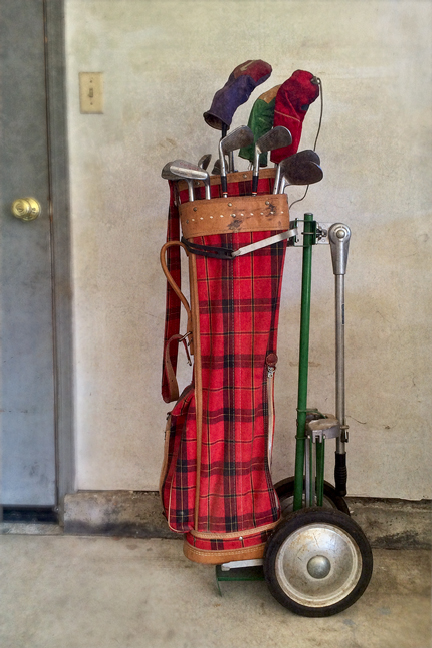
Dad’s ancient set of golf clubs, which he may have inherited from his father. I don’t remember Dad ever playing golf, but these clubs were right there in the garage, ready for a trip to the links.
A close-up of the golf bag.
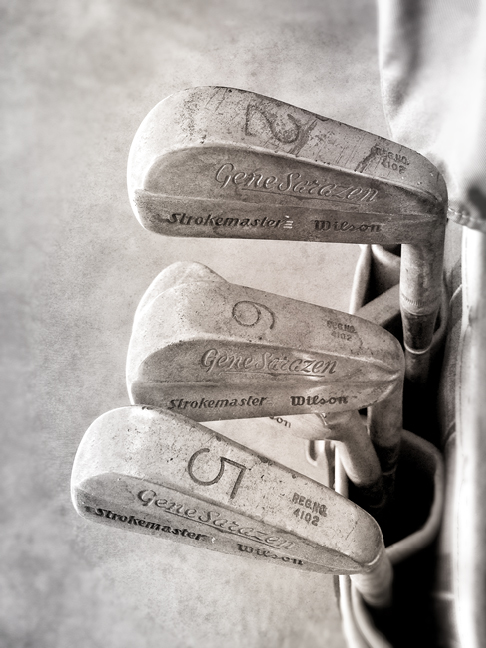
Dad’s Gene Sarazen clubs, made by Wilson. Sarazen was one of the world’s dominant golfers during the 1920s and 1930s. He invented the sand wedge still in use today, and was an advisor to Wilson for 75 years.
Dad’s shoe polish box, which he used for as long as I can remember (I’m sure it predates me).
Dad’s toolbox, wonderfully scuffed and stained and banged up after a lifetime of good use. It usually sat on his workbench, which he built in shop class at the age of 14. As a child, I was fascinated by that workbench, where creativity bloomed and problems were solved.
There were more tools outside the toolbox than inside it. This is a view of the workbench, whose surface is barely visible under all that stuff.
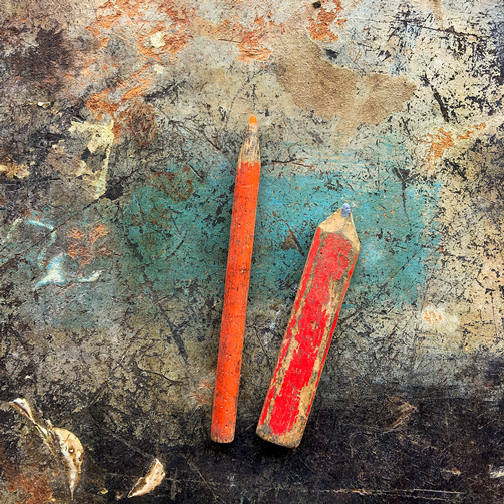
Our last day in the garage, after nearly everything was out of the house, one of Dad’s neighbors stopped by and asked if he could be of help. He ended up cleaning out the workbench, a kind and helpful thing for him to do for us. When he was finished, he said he’d found these two pencils in the drawer, and I thought they made a nice photograph on the fascinating surface of that bench.
One day when I was visiting Dad, a lifelong smoker, I found these three partially-smoked cigarettes sitting on the workbench. I titled this photograph “Tres amigos.” After Mom died—a heavier smoker than Dad—he stopped smoking inside the house, and his workbench became one of his favorite spots for a smoke.
Yes, this is disgusting, but it’s also a classic demonstration of how my dad thought. Why throw away an old coffee pot when it could live a second life as a partially-enclosed ashtray?
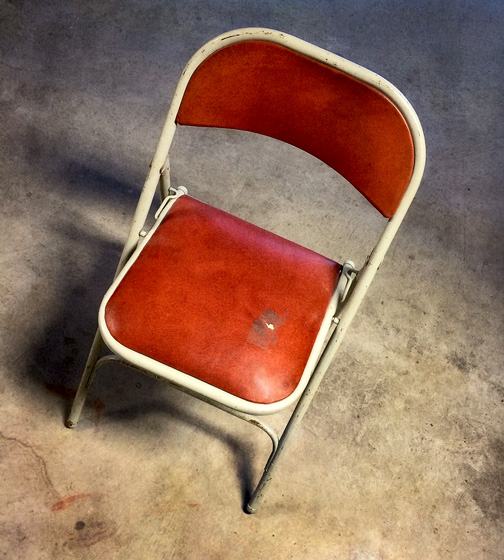
One of Grandma and Grandpa’s folding chairs, the one Dad would sit on to enjoy a cigarette and brush the dog.
The casinos in Reno, my hometown, always gave out shiny, sparkly party hats on New Year’s Eve. I wish I knew what year these are from, but I can say that they were in Dad’s garage for a good many years.
My grandfather—Dad’s father—was in the dry cleaning business in Reno. At one point, he had several shops around town where people could drop off and pick up their items, and I think that Grandpa had things like this in his shops to provide refreshments for customers. When the business was consolidated and several of the shops were closed, Dad saved a bunch of items like this one. A man named George Washington—possibly a distant cousin of the first U.S. president—had pioneered a way to make instant coffee, and in 1910 he founded his namesake company to go into production. Three cups of coffee for ten cents. I’d guess that this dispenser dates to the late 1930s, and I notice that it also sports the Good Housekeeping Seal of Approval.
In 1937, a staff member at G. Washington figured out how to make a dry instant broth, and the company marketed it just as it had done with instant coffee. This broth dispenser dates to between 1938-1945, and states that the broth is meat-free, fat-free, and contains flavorings and colorings.
A fabulous old flavored-drink dispenser, which also looks like it dates to the 1930s. This photograph shows the heavy ceramic base, which held a large glass jar with a spigot. I adore the lettering here.
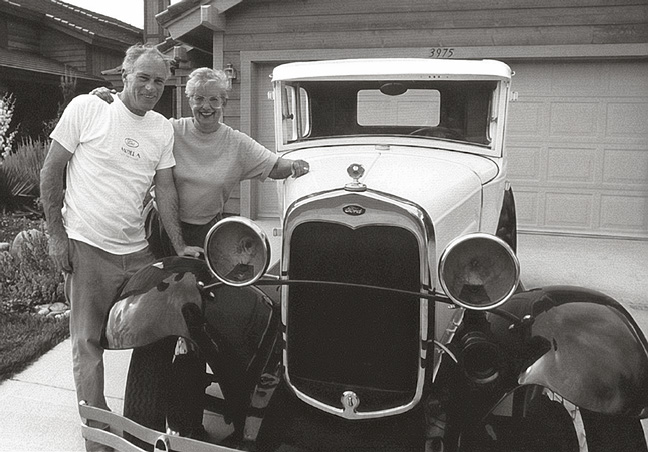
The main event in Dad’s garage was his creamy yellow 1931 Ford Model A, which he bought in parts in the early 1980s, and then spent years rebuilding into a street-worthy car. Dad was born in 1933, so the car was older than he was, hence the license plate.
My parents with the Model A in front of their house. My nephew called it the Ah-ooga car, because of the sound of the horn. That car was an incredible good-will ambassador, leading to big smiles and happy waves as she put-put-putted down the street. My husband Dale and I rode in the rumble seat when our two fathers drove us away from our wedding.
After Dad died, the car was purchased by our cousins Sam and Anne, and now she makes people smile in Michigan. I think Dad would be pleased.
This has me thinking about my Dad & Mom, also both children of the depression. Oh, the things we found when we cleaned out their house. But they were also the ones we turned to when we needed a screw or a nail or some other obscure object that just 1 was needed, not a package of 20.
So funny, Cathy, I was just thinking the other day about a stationery store I where I used to shop. I could go in and buy ONE pen, but nowadays we have to buy five or ten at a time, packaged in weapons-grade plastic. It’s both funny and pathetic, but let’s focus on the funny, eh? That, plus the memories so many of us have of cleaning out the homes of loved ones. Thanks for sharing your own story with me!











What a beautiful tale about your Dad, thank you for sharing. ❤
LikeLike
What a beautiful tale about your Dad, thank you for sharing. ❤
LikeLike
Hi Candace, thanks so much for your nice comment. I’m glad you enjoyed the journey! ❤️
LikeLike
This has me thinking about my Dad & Mom, also both children of the depression. Oh, the things we found when we cleaned out their house. But they were also the ones we turned to when we needed a screw or a nail or some other obscure object that just 1 was needed, not a package of 20.
A lovely tribute to your dad.
LikeLike
So funny, Cathy, I was just thinking the other day about a stationery store I where I used to shop. I could go in and buy ONE pen, but nowadays we have to buy five or ten at a time, packaged in weapons-grade plastic. It’s both funny and pathetic, but let’s focus on the funny, eh? That, plus the memories so many of us have of cleaning out the homes of loved ones. Thanks for sharing your own story with me!
LikeLike