Grab a Hunk of Lightning

Migrant Mother, photograph by Dorothea Lange, Nipomo, California, 1936
Dorothea Lange

It’s not often that a film inspires me to write a blog entry, but here we are. I have been inspired, and I’m writing about it. The film is Grab a Hunk of Lightning, a story about Dorothea Lange.

Lange was among the greatest twentieth-century American photographers; she made the iconic photograph above. Due to bad timing, it very nearly didn’t happen: it was raining, and the camp of pea-pickers hadn’t worked that day. After a long and tiring day of work, Dorothea decided to drive right past the entrance to the camp, and almost immediately she second-guessed herself. She turned around and drove in.

Somewhat later, she sent that photograph to her boss, and suddenly it was everywhere.

She wasn’t paid for it and she was rarely credited.

Eighty years later, Dorothea’s granddaughter Dyanna Taylor has filmed an evocative story about Dorothea, her loves, and her life with a camera in her hand. There are people who will enjoy this film because they are themselves artists and creators; there is plenty here for them. But there are myriad other reasons to watch the film: it will encourage you to look around yourself with greater awareness; you will learn something about American history, especially the Depression era; and not least, it is a beautiful and sensitive portrait of a remarkable woman of immense skill and vision.

Click here to watch the trailer and learn more about the film.

White Angel Breadline, San Francisco, California, 1933.
Man in Archway, Pakistan, 1958.

A joint effort by three winemaking entities, some of the proceeds from the sale of bottles of Ciel Rouge (Red Sky) will go to support the region’s firefighters. The photograph of the fire that’s seen on the label was taken by the family who own Château les Palais; it’s their view from the family home shortly before they evacuated.
The flames and the phoenix

On August 5 this past summer, a fire of terrible ferocity began in the Corbières region of Aude, the département where I live in the South of France. The fire started in Ribaute, and grew quickly to envelope multiple villages. At its worst, the fire burned nearly 2,500 acres an hour; it was finally brought under control three days later, after destroying over 32,000 acres. It was the most catastrophic wildfire in France in 75 years.

A wildfire instills a primal fear that is unlike other fears. I clearly remember how I felt when I glanced out my window and saw the flames. We had already had several destructive fires, so I knew right where to look online to learn the location of this one. The only fire I could find was 30 kilometers away (18.5 miles)—surely that was too far away because I could see the flames themselves rising high in the sky. And yet… this was indeed the fire that I could see, from the safety of my home.

Last week my friend Sue and I decided to take a drive to the village of Saint-Laurent-de-la-Cabrerisse, one of the hardest-hit by the fire, to say hello to a few winemakers we know, and to show our support.

“L’Ogre des Corbières” is the monster of the Corbières; i.e., the horrible fire of 2025. The drawing is by a family friend, and the distinctive church tower is a symbol of the village.

Our first stop was Château de Saint Eutrope in the center of Saint-Laurent. This was a new winery to both of us, a recommendation from another friend. We received a warm welcome from Emilie, one member of the Verdale family that has worked these vines for five generations.

The recent bottling of L’Ogre des Corbières is their last for a while; all but eight hectares were destroyed by the fire, and those eight sustained smoke damage. As Emilie said, it’s heartbreaking, and they really don’t know if they’ll still be making wine in the future.

We enjoyed speaking with Emilie, and we bought a few cases of wine before saying goodbye. I hope I’ll get to see her again, and drink more of their fine wines.

A portion of the sales of Ciel Rouge (Red Sky) will go to our regional firefighters. The photograph was made from the family home at Château les Palais, just before everyone evacuated.
At Château les Palais, the family home is seen behind a huge fountain and some of the very few trees that were saved from the fire.
The cave at Les Palais is a 9th-century convent chapel.

Our second stop was at Château les Palais, which has also been in the same family for several generations. The property is extensive, and it includes a chapel from a 9th-century convent that used to be here. It’s quite a building, and the wines are delicious, too.

They also participated in a flame-inspired bottling, and in this case, a portion of the proceeds will benefit the region’s firefighters, as well as property owners who experienced especially hard losses.

Château les Palais lost all of their vines, as well as a great many olive trees and old parasol pines.

Wine bottles marching up the 1,200-year-old steps of a chapel.
Part of the view of Saint-Laurent-de-la-Cabrerisse from the terrace where we enjoyed a tasty lunch on a lovely autumn day.

We returned to the center of Saint-Laurent for a delicious lunch on a terrace overlooking the Nielle River. The restaurant, La Vielle Dame, was nearly full, and everyone was smiling, relaxed and happy to be exactly where they were on this sunny day.

After lunch, we took a short stroll around the picturesque village, and found that this is a place that takes great pride in its history. Historic markers abound, with photos and maps recounting the very long story of this village.

The remarkable doorway of a late-13th century house.
A cozy setting in an ancient courtyard.

We finished our day with a final stop at one of our favorite wineries, where we enjoyed a nice conversation with the vigneron.

It had been a nearly perfect autumn day, with a vivid blue sky and a tiny bit of chill to the occasional breeze. People were smiling as they made their way through their day.

But there was desolation, too, as we saw huge swaths of bare earth and blackened twigs where there once had been vines and trees.

Emilie Verdale recounted how her grandmother had remained in her home, even as the flames crackled just outside her window, and her brother Maxime said, “We are the fifth generation to work on the estate. We don’t want to be the last.”

Anne de Volontat, of Château les Palais, recounted that every one of their vines was lost to the flames, but when she spoke, her eyes held a steely defiance that spoke of a determination to bring their land right back to glorious life.

Phoenix rising, indeed.


A Sensory Summer

Smell: the lavender of Provence
The final part of my trip to Italy was two days spent in lavender country in Provence. In planning my trip, I realized I’d be driving back into France right around peak lavender bloom, so I made arrangements for a few nights in Valensole, right in the heart of the action. I arrived a week before the local lavender festival, so I guess the timing was about right!

Four years of drought and the lateness of this year’s spring rains had left the lavender plants in a state of distress, not as full, lush and vivid as in other years. That said, it was my first view of the stunning blue-purple fields, and they were gorgeous!

Fat, straight violet lines, rounded on top, lead the eye across the landscape and toward mountains turned hazy blue in the distance. The sky above is a brighter blue, and adjacent fallow fields are pale gold. In the midst of many of the lavender fields, one spies a single tree or a stone hut.

These stone huts, called cabanes, are old, built in a drystack technique (no mortar or cement) that is all but lost in modern times. Cabanes were generally built from the late 1600s to the late 1800s, and had a variety of uses: shelter for animals or people, storage of tools or food, and—less common—to protect a water well or spring. They were outbuildings of a farm, often built as part of a stone wall. They are a basic aspect of the rural landscape of southern France. In Provence, the warm gold hue and rough stone texture of these cabanes make a great foil for the perfumed purple glory of all that lavender. It is a feast for the senses.

Continue reading “A Sensory Summer”

In love

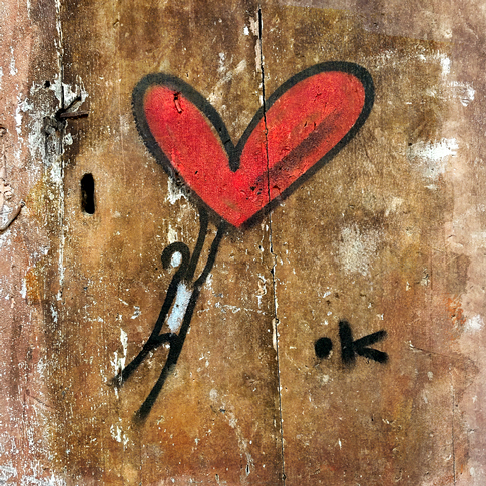
Love Balloon Siena
Street art in Siena, by one of my favorite artists. “Love Balloon Siena”

I have fallen in love. His name is Ruchè (roo-KEH). He lives in the northwest of Italy, in the area known as Piemonte (Piedmont in English).

But before I divulge the details, let’s go first to the beginning of the day when it all happened, when I was awakened in the early morning by a crashing storm that brought loud thunder and pounding rain. I had thought I might arise early, and go for a walk to explore the little hilltop town of Castagnole Monferrato before breakfast. But the dark skies and the pouring rain helped me make the decision to stay in bed and sleep a little longer. Thunder gets my pulses going, but steady rain lulls me to sleep.

Continue reading “In love”