Ireland 2025, Part One

This past August marked my third trip to Ireland, and yet again, it was absolutely wonderful. There are a great many stories to tell, and a lot of photos, so I’m dividing this into two rather long posts. This post covers the first week of my trip, when I was on my own; the next post will cover the 2½ weeks I spent with friends who wanted to share with me their favorite spots in Northern Ireland. (Hint: it was fantastic!)

The first week of my holiday was both slow and full, and my favorite part was all of the warm, friendly people I met along the way, each with his or her own fascinating story. What an amazing gift it was to spend time with all the remarkable people I met on this journey.


Part one: Drogheda

Day 1 • The Battle of the Boyne

I was in need of some time taken at a slower pace, so I began the trip with a few days at a lovely B&B where I had stayed two years ago. The owners—Michele and Arthur—have opened up the home where they raised their children, and it is a welcoming and beautiful home away from home.

The house is located in the countryside near the city of Drogheda. Should you find yourself wanting a cozy place to stay an hour north of Dublin Airport, search for “Drogheda Buvinda,” and you’ll land in the right place.

Road signs near the Battle of the Boyne, and high-fiving the pedestrian dude.

I didn’t want to drive that first day, so I took myself on a walk up the hill to the site of the historic Battle of the Boyne. Battle sites don’t generally captivate me, but there’s an interesting bit of history here. The battle took place in 1690, between the forces of King William III of England and Scotland (William of Orange), and the deposed James II.

The battle, though not the only one fought during this time, had an outsized effect on the course of European and American history, as it helped maintain the ascendancy of the Protestant rulers of England, and the Parliament that was a cornerstone of their way of governing. James, a Catholic, was fighting to regain his crown, but the Irish were also fighting for independence from England, and losing the Williamite War led to a long period of struggle that still isn’t fully resolved.

After an informative stop in the visitor center, I wandered through the lovely gardens and then ducked into the café for a bite to eat. It was packed with people, but I found a table and sat down to eat. Partway through my meal, two gents approached and asked if I was willing to share my table, as the place had become even busier and all the tables were taken.

I was happy to share, and of course, we all ended up in a lively conversation, trading stories of places we’d visited and observations on life in general. Too soon it was time for them catch their ride, so we said our goodbyes. I finished my meal and went outside, where I saw something new to me: bicycle rickshaws. As I walked past them, I turned to look, and saw my two gentleman friends, each sitting regally in his own rickshaw. They invited me to take a seat inside, and our earlier conversation picked up right where we’d left it.

It turns out that the city of Drogheda has a program called Drogheda & District Support 4 Older People, which includes these vehicles called trishaws. Each is powered by someone riding a bicycle at the back, and in front is a covered carriage that holds two people.

As we sat there chatting, we were approached by a photographer from The Irish Times, asking if he could take some photos for possible publication in the newspaper. I started to leave, but oh, no! They wanted me to stay. I don’t know if we made it into print, but below is one of the photos from the photographer; happily, it also includes the two cheery cyclists.

The whole episode was a hoot, and left me with a huge smile on my face. This trip was getting started in fine style!

As I walked back down the hill, I spoke briefly with a plein-aire artist working beneath one of the huge old trees on the grounds, and moments later I saw the setup for another artist, although there was no sign of him. Eventually, he appeared; I told him how much I admired his painting, and asked if I could buy it.

He was a little surprised by this, and it took some coaxing to get him to even consider the possibility. Wet paint was one issue to be dealt with, which then led to the question of how to get the painting to me. We exchanged contact info, and I learned that his name is Michael; we kept in touch over the next few weeks, and then suddenly I stopped hearing from him. I figured it was his way of backing out of the deal, but then just as suddenly I heard from him again. Some time after that, Michael’s painting arrived, and I’m quite pleased with it.

The Boyne Oak, a tree that was documented to exist at the time of the Battle of the Boyne in 1690. On the left is my photograph of the great tree, and on the right is Michael’s lovely painting of it.

I made my way back to the B&B, feeling a bit giddy after two enjoyable interactions with the lovely locals.

One of Michele’s gorgeous roses in her garden at Buvinda B&B, near Drogheda.
Day 2 • Kells

The village of Kells lent its name to the magnificent Book of Kells, which I saw in Dublin two years ago. It hadn’t occurred to me that there was a town with that name until Arthur mentioned it to me just before I left for the airport at the end of that vacation. It was promptly added to my ever-growing list of places to visit in Ireland, and this year I was determined to see it.

What had piqued my interest was when Arthur said that the building where that great book was completed still sits in the village. This seemed a miracle, because the Book of Kells dates to the early 9th century. I had to go see it!

Adam and Eve depicted on the Kells South Cross, also called the Cross of Saint Patrick and Saint Columba, carved in the ninth century.
The photo at left shows the east face of the South Cross. The above detail of Adam and Eve is on the left side of the second section from the bottom; the right side shows Cain slaying Abel. Above right is an oratory called St. Columba’s House (10th c.), located just uphill from the churchyard.

The monastery at Kells was founded by the early Irish evangelist Columba (Irish: Colum Cille) in about 554 CE. After a dispute, Columba and twelve companions left Ireland in a leather-covered boat (currach) and went on to found the Iona Abbey in Scotland in 563. He died around 593, after a busy life of teaching, writing, founding abbeys and churches, and making several journeys home to Ireland. Apparently he was also a skilled diplomat, helping to ease tensions between warring tribes.

The Kells monastery was refounded in 807 by monks from Iona, and the building of the abbey and church took seven years, being completed in 814. None of these buildings still exists, but there is a round tower (10th c.) and several high crosses (9th-10th c.) I hoped to see.

Alas, the tower was undergoing what was probably much-needed restoration work, and was completely covered by plastic-sided scaffolding. I saw not the tiniest portion of those ancient stones.

But the quiet little churchyard was speaking to me. I could feel the millennia here, with millions of footfalls and the trees whispering like so many voices. There are three high crosses in the churchyard, plus the base of a fourth; one is damaged, one was never completed, and the third is the fantastic South Cross, also known as the Cross of Saint Patrick and Saint Columba (shown above).

The building called Columba’s House is a 10th-century oratory, making it 400 years too recent to have actually been the saint’s residence, although it may have temporarily housed his remains. This remarkable structure was built without mortar, and it is possible that there is an underground passage connecting it to the nearby church.

It is said that the Book of Kells, an undertaking begun on the island of Iona, was completed in Kells, thus the name, but there is no evidence that Saint Columba’s House was the scriptorium of that period. It makes a terrific story, though!

On the trail up to the top of Carnbane East, one of several megalithic sites at Loughcrew. As I passed, a curious cow meandered over to check me out.

From Kells, I traveled further back in time with a visit to the megalithic site at Loughcrew, a sprawling preserve that covers four hills. Carnbane East is the most-visited, with a nice hike to the top to enjoy the view while surrounded by cairns, burial chambers and rock carvings dating to around 3400-3000 BCE (before Stonehenge and the Egyptian pyramids). The area is known locally as The Witch’s Hill (Sliabh na Cailleach).

The burial chamber known as Cairn T at Loughcrew is about 115 feet (35 meters) across. The passage opening is aligned to the sunrise on the spring and autumn equinoxes.
A carved stone just inside the entrance to Cairn T.
Cairn U is a great deal smaller, with the passage and chamber measuring about 23 feet long (7 meters). It contains quite a few remarkable stone carvings, and boasts a nice view of the Boyne Valley below.
The trail passes through a peaceful shady area at the bottom of the hill.

I looked at the sun and decided that I had time for one more stop, so I drove to Mellifont Abbey. When I arrived, everything looked closed, and I realized that while the sun was still relatively high in the sky, I had arrived after the 6:00 closing time.

Good news, though: while the visitor center was now closed, the site remains open all the time, and due to the hour, I nearly had the whole place to myself.

Mellifont Abbey was founded in 1142 (An Mhainistir Mhór) by Saint Malachy, a friend of Saint Bernard, who had founded the Cistercian Order in France. Mellifont was the first and greatest of many Cistercian abbeys in Ireland. In 1152, the abbey hosted the Synod of 1152, which asserted the authority of the Church. After the dissolution of the abbeys under Henry VIII, parts of the abbey were incorporated into a fortified house, which was used as the headquarters of William of Orange during the Battle of the Boyne. The buildings are now mostly in ruins, but there are enough traces to understand the wealth and scope of the great abbey during its heyday.

The lavabo at Mellifont Abbey. This remarkable eight-sided Romanesque building had water piped in from the nearby river, and was used for the monks to wash their hands before eating in the rectory. In French, “lavabo” is usually used for a bathroom sink.
A detail of one of the columns in the Mellifont lavabo.
A fabulous green tunnel on the way to dinner, at the end of another great day.
Day 3 • Drogheda

I took one day to explore the city of Drogheda on the banks of the River Boyne. The city dates to 1194, when Norman settlers received a charter to settle here. Millmount Fort, high on a hill overlooking the city below, dates to this era and now houses a fine history museum. I began my tour here, then walked downhill for a stroll through town.

The 13th-century barbican known as the Saint Laurence Gate.
The history museum has a section dedicated to various aspects of communication; there’s a section of the original Transatlantic cable. I noticed an old Bakelite telephone that looked just like one my grandparents had; my guide agreed to dial the phone to see if it sounded the same, and it did! I’ve carried that exact sound with me all these years, and it was fun to hear it again.
A relic from a different time.
A classic Irish bar.

Part two: Dromintee

Day 4 • A stained glass pilgrimage

I left the Drogheda area and drove a short distance north to visit friends Ailís and Kevin, whom Amy and I had met last year at an overlook point in Donegal. Along the way, I planned to stop at a tiny country church, in search of a particular stained glass window.

If you’ve been reading my earlier posts on Ireland, you’ll know that I’ve completely fallen for Irish stained glass (same link above). I particularly admire the work of Harry Clarke, whose work spans only a short time, 1910-1931. Along the way, though, I’ve learned of other artists, including a contemporary of Clarke named Michael Healy.

I have a book on Irish stained glass, and on the cover is a photograph of a window of the most extraordinary quality. It went right to the top of my list of windows to see in person. It’s part of a larger work by Healy, Doubting Thomas, and Judith; the window was commissioned to commemorate a local couple, Thomas and Judith Treanor.

What caught my eye and captivated my imagination is Judith’s luminous silver-blue dress. My brain knows that this is an image made of glass, but that dress looks like the finest diaphanous fabric. I had to see it.

Michael Healy’s full window (1923), Doubting Thomas, and Judith, in the Brid a Crinn Church, County Louth.
The Judith panel of the window.
That skirt! The detail is extraordinary in a work of glass, and Healy incorporated a variety of staining and etching techniques to achieve the look. It’s exceptionally beautiful.

Leaving the tiny country church with a satisfied spring in my step, I turned the car toward Saint Brigid’s shrine, where I was to meet Kevin to follow him home. I don’t know much about Saint Brigid, except that she’s often grouped with Saint Columba and Saint Patrick as Ireland’s patron saints. I thought it would be interesting to see her shrine.

When I arrived, there were one or two other cars in the parking lot, but rather quickly, the place was filled to overflowing: older couples strolling the grounds, families spreading blankets for picnics on the grass, children running around and laughing. I was confused until it was later pointed out to me that the day was Assumption Day, a major feast day on the Catholic calendar.

I did have time to walk around; I was able see the shrine itself, to walk among stately old trees, and I even had a brief conversation with one couple. Somehow, we landed on the topic of the Judith window at Brid a Crinn, and both of them looked at me in astonishment. “That’s our church!” Oh, my. That was followed quickly by “We’ll be there later this afternoon for a memorial service, and we are going to look for this window.” It was a small-world moment that all three of us relished.

Moments later, my phone buzzed, and I learned that Kevin awaited me in the parking lot below. I hurried back, we hugged hello, and then he gave me surprisingly precise directions for following him to their house, necessary because their narrow, winding road would not be fun to navigate if one were to meet a car traveling in the opposite direction. Kevin planned to go far enough ahead of me to essentially block the road for me, which I was grateful for.

It was delightful to see them all again, and we went back out later for a drive along the coast and then dinner at a favorite local restaurant.

Day 5 • Kilnasaggart

Ailís and I went to see the fine standing stone at Kilnasaggart, quite close to their home. We walked through two empty fields to find the stone standing alone in a third field, which turns out to be the site of an early Christian cemetery. It’s a quiet and peaceful place, but it’s near one of the major north-south roads connecting Ireland with Northern Ireland, a road that has been used for millennia by merchants and warriors alike. This stone has witnessed a remarkable slice of Irish history.

The inscription in Irish says that Ternohc, son of Ceran Bic, put this place under the protection of Peter the Apostle. Ternohc’s death is recorded in either 714 or 716, which dates the stone to the early 700s. The above-ground portion of the stone stands about 6.5 feet (2 meters).

The inscription in Irish dates the stone to the early 700s.

After our brush with the past, we decided to have a wander around Carlingford, a picturesque bayside village on a sparkling blue-sky day. We’d been hoping to browse shops and pause for a cuppa, but our timing was off and most places were already closed. But it’s lovely place, worth a return visit one day. Besides shops and appealing bars, there’s King John’s castle, so named because the English king visited in 1210.

PJ’s, a bar in Carlingford.
Part of what makes it exciting to drive in Ireland.
Day 6 • Seeing an old family home

Ailís and Kevin have two active and energetic children, and their home buzzes like a beehive. It’s wonderful! I’d hoped to be able to see their daughter playing Gaelic football, a game I know nothing about, but unfortunately her team’s weekend activities were cancelled. The kids still had plenty to keep them busy, though, and that meant that their parents were just as busy, shuttling young ones to this practice or that slumber party. I was happy to just visit with them when I could, but Ailís also did a great job as a local tour guide.

On my last full day there, soccer was the order of the day, and we sat down to lunch with another mom, who had the young fellah home after practice. When it was time for her to leave, she had the idea that I might like a visit to her old family home, now owned by her brother and run as a holiday rental. Of course, said I, and off we went.

We had a full tour of the property, seeing several small buildings and other structures before entering the main house. The building dates to 1768, and the original part of the house has been beautifully remodeled to look much like it did when the siblings’ grandparents lived there. Low ceilings and doorways and very deep windows give a cozy feeling that is augmented by a great many family photos lining the walls.

Another building, the cow barn, has more living space and one of the glories of the property: a complete and authentic wooden bar where guests can tap a keg during their stay. This space is packed full of all kinds of memorabilia, like antique farm tools, old advertisements, and signed photos of actors. It’s endlessly fascinating, this remarkable collection that the owner has gathered.

“An teach bó” translates to “cow barn.” This is the structure that houses additional living and sleeping space, plus an authentic wooden bar where guests can set up a keg to be on tap during their stay.
The property is chock full of interesting memorabilia, such as the vintage Guinness sign at left. At right, beneath the harp of Ireland, is the construction date of the house, carved into one of its stones.
One day, Kevin pointed to these white lines marking an intersection near their home, saying, “Those lines are the border between Ireland and Northern Ireland.” Ailís disputed this, and it became a running story of the weekend. I decided that I needed a photo with one foot in each country, and here it is. I’d guess that the actual border runs down the middle of the road that’s on the right side of the photo, but there’s no painted line to make an interesting photo!
Day 7 • Driving back to Dublin

The time came to bid a fond farewell to Ailís and Kevin and their family, but not before Ailís insisted that I take a detour to see the Hill of Faughart, a small hill with an outsized place in Irish history. Kevin again guided me through the especially narrow and twisty part of their road, and we waved goodbye to each other.

One view from the Hill of Faughart.

The Hill of Faughart is hard to pick out from a distance; it’s not a tall hill, nor does it have noticeable features. That’s deceiving, because it holds a place of honor in Irish history, mythology and religion.

Faughart is a drumlin, a particular kind of rolling hill that is unique to this region of Ireland. This landscape provides natural protection, fertile soils and abundant resources; humans have lived here since the Mesolithic Era, 7000-4000 BCE.

The landscape in this region, not far from either mountains or the sea, also means that Faughart occupies a strategic point along the north-south routes that have been used for millennia.

What may be seen today is primarily the remains of a medieval church and a cemetery with several points of interest, although aerial photography has revealed agricultural lines that may date to the Bronze Age. There is also the ruin of a small Norman-style motte, a kind of defensive castle.

Faughart is reputed to be the birthplace of Saint Brigid, around 450 CE. She is one of the patron saints of Ireland, and this is a place of pilgrimage. The main location is a holy well, with water that is claimed to be curative. There are two other sites dedicated to Brigid as well.

In 1318, a great battle was fought here. Edward Bruce, King of Ireland and brother of Robert the Bruce of Scotland, was killed during the battle and is said to be buried here.

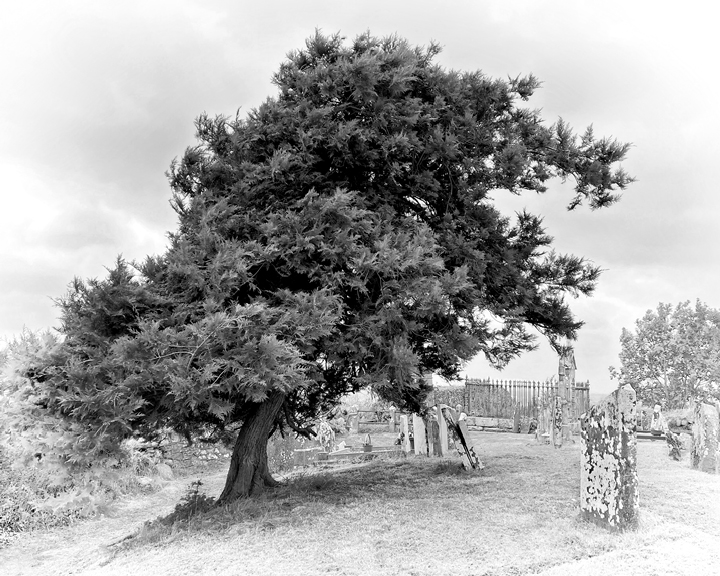
The black-and-white photograph at the top of this post is from one edge of the cemetery.

The reputed grave of Edward Bruce, killed in battle here in 1318.

I left Faughart behind and turned the car south toward Dublin, but I had one more stop along the way: Monasterboice, a place I’d visited on my first trip to Ireland.

The high crosses here—dating to the 9th-10th centuries—are considered among the finest in Ireland, and they really are outstanding works of stone carving. The site is near the road I was traveling, and it was an easy detour to see these beauties again.

The West Cross at Monasterboice. It’s the tallest in Ireland, at about 23 feet tall (7 meters). Probably dating to the 10th century, this remarkable cross still stands tall and straight, defying age and the weather, and continues to tell its biblical stories.

This graveyard has been used by both the abbey and the people of the region for over a thousand years, so I was poking around to see if I could see a few of the oldest markers. I couldn’t find one that I’d read about, so I walked back to the visitor center—a tiny cabin at the entrance to the cemetery—to see if someone there could help. There were two people on duty there, and they were speaking with other people, so I hung back. A woman eventually approached and asked if she could be of help, and when I told her what I was looking for, she immediately said she’d walk back with me to see if we could find it.

We chatted a bit as we hunted, and we did find the slab, nearly hidden amongst many other memorial stones. As we began the walk back, she pointed to the 10th-century tower and said that her husband had proposed to her at the top of the tower.

Well, here’s a story! Back in 1982, two young locals were dating, and things were starting to look serious. One night, they went into the tower and climbed up—she told me she was scared—and once they’d reached the top, he popped the question. She said yes right away and they made their way back down.

Very shortly after that episode, the tower was closed, and can no longer be climbed.

I clapped my hands in delight at this fine story, and she told me that the other person greeting visitors was her husband. Would I like to meet him? Absolutely, said I, and then I asked if they’d be willing to have their story and photo in my blog. Absolutely, said they, and thus here we are. I present to you Terina and Kevin, the happily married couple, posing with “their” tower!

The Monasterboice Round Tower dates to the 11th century, and stands 98 feet tall (30 meters). Historians aren’t entirely certain of the reason for these towers, which are found throughout Ireland and Northern Ireland, but there are some interesting details. They were all built around the time that Vikings were raiding Ireland. The access door is raised off the ground by a significant amount, and the towers were built without permanent stairs inside. The most common thought I’ve read suggests that the towers were used to preserve an abbey’s treasure, including books, as well as providing a place for monks to retreat into during raids. A ladder was used to enter, then withdrawn, and more ladders were used to climb to the highest reaches of the tower, also withdrawn as the monks climbed higher. Like the high crosses, I find it remarkable that these towers have stood tall for over 1,000 years.

What a treat to have met Terina and Kevin, who were so friendly and welcoming, and who so generously shared their story with me (and you!). We chatted a while longer, and then it was time for me to continue my journey.

I found a place to get a small bite to eat, then continued on toward the Dublin Airport, where I returned my rental car and found the hotel where I’d soon be meeting my friends for the next part of this extraordinary journey.


Parting shot

The photo above shows the underside of one of the high crosses at Monasterboice. A hand can signify so many things, but in this case, I’m using it to wave good-bye to you until we meet here again.