

A quick trip to Nantes
I had read about an exhibit on Genghis Khan, to be shown in the city of Nantes, and it seemed like an interesting thing to see. My friend Kitty is also a history buff, and we decided to make a short trip to see the show. Our flight touched down in time for dinner, and two days later we left on a mid-afternoon flight. It was a brief but wonderful getaway.
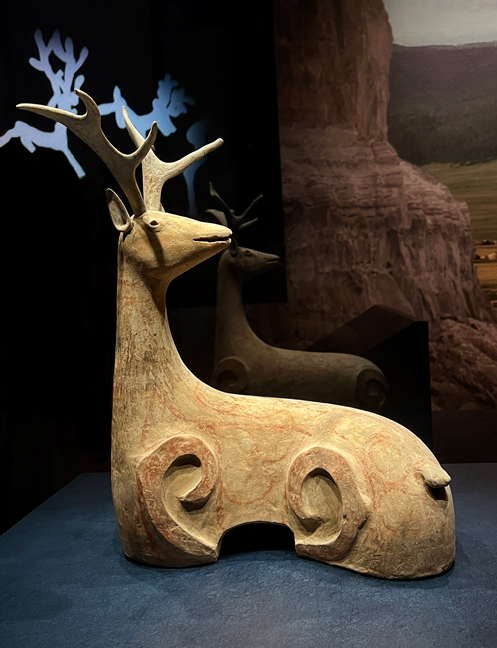
Genghis Khan
For the first time in France—ever—an exhibit about Genghis Khan currently appears at the history museum of Nantes, located at the Château des ducs de Bretagne (until 5 May 2024). There are several hundred objects never before seen in Europe, including some items found as recently as three years ago.
The show nearly didn’t go on, being delayed for three years to work around the demands of the Chinese government. Among other things, the Chinese insisted that the exhibit refrain from using the names “Genghis Khan” and “Mongolia,” which renders the whole exercise rather ridiculous. They also wanted full control over all published materials; in other words, they hoped to use this exhibit to rewrite history.
So the exhibit’s curators switched direction, and instead of working with a museum in Inner Mongolia, which is part of China, they began working with museums in the separate nation of Mongolia.
The first section of the show is devoted to thoroughly setting the stage, starting with a description of the paleontology and geography of the region, to enable visitors to have a sense of the land, its weather, its animals, and its early nomadic people. There is a woolly mammoth tusk from 2.6 million years ago, and a great many small works of art from the Neolithic and Bronze Ages.

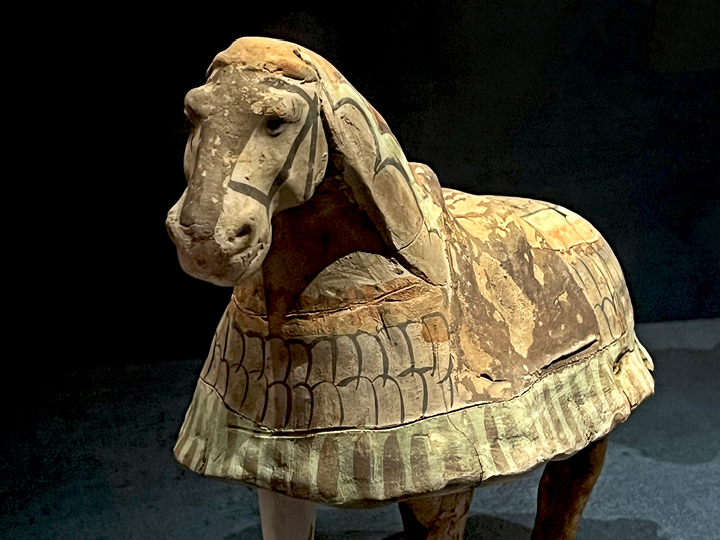
Genghis Khan was named Temüjin when he was born in 1162. The Mongolian steppe was a place of nomadic warrior tribes; skirmishes were part of daily life. Temüjin began coalescing his power by subduing these tribes, and he was elected leader at an assembly called a kurultai in 1206. The leader was called a khan; he added the name Genghis, meaning universal or supreme.
So much of what we think we know about Genghis Khan relates to a great deal of warfare and bloodthirsty quest for power. The exhibit we saw in Nantes attempts to round out the story, to show other aspects of Ghengis Khan’s extraordinary rule and huge impact on the world, still felt today.
At its height, the Mongolian empire spread from the Korean peninsula in the east to Hungary in the west, from Lake Baikal in the north to ancient Persia and modern Laos in the south. It is the largest contiguous empire in history, double the size of the Roman empire and four times the size of Alexander’s territory.
Perhaps one of the most influential items from the Mongolian empire was its own maps of its territories, some of which eventually found their way into 15th-century Europe, fueling the waves of exploration by men such as Columbus, Magellan, John Cabot, Coronado, Vasco da Gama and many more.
The great expanse of the Mongolian empire also meant that there was an enormous range of influence in religion, the sciences, the arts, and even methods of government. The Mongols were known to be unusually tolerant of other religions, allowing people to continue their worship as long as they added a prayer for the success of the empire. Living together peacefully were Buddhists, Taoists, Muslims, Jews, Christians and many others.
We saw a large range of ceramic pieces that combined influences of the great traditions of Chinese pottery with decorative forms from other areas such as Persia.

The wives of rulers and commanders were themselves powerful, and were almost single-handedly in control of daily life in their nomadic communities. Many women participated in the kurultai, the great regional assembly of political and military life in Mongolia, and there were women who fought as warriors or rose high in political life.

The Mongolian Empire came to an end through a combination of factors. Once held together so powerfully, it was perhaps inevitable that there would be fractures within and between ruling families, leading to raids by other peoples and the loss of territory. The bubonic plague—the Black Death—also played an outsized role, spreading quickly throughout the entire empire. That said, some of the individual states survived into the 17th and 18th centuries.

Les Machines de l’Île
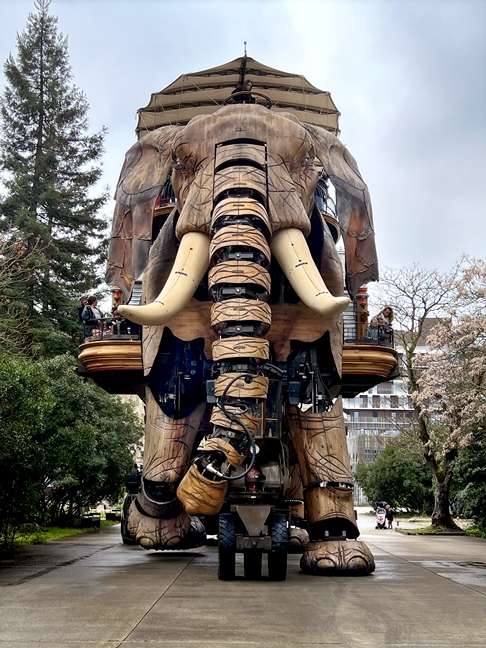
After a nice lunch in the historic Bouffay quartier, we walked toward the old Nantes shipyards, home to Les Machines de l’Île, an animated steampunk dreamland. I had heard about these wondrous mechanical creatures, and hoped for a ride atop the massive elephant.
First, though, was a delightful hour or so spent inside the main hall, watching happy children get their chance to ride on some of the machines and work the controls. We saw a huge spider, a caterpillar, mosquitos, and birds.
Some of the animals inside the hall are destined to live in the massive Heron Tree, projected to be completed in 2027. These include the giant sloth below, a hummingbird that pokes its beak into a flower to gather nectar, and a chameleon that darts its tongue out to catch a fly. We also got to fly up to the ceiling, soaring above the crowd, riding in baskets below the wings of a heron.
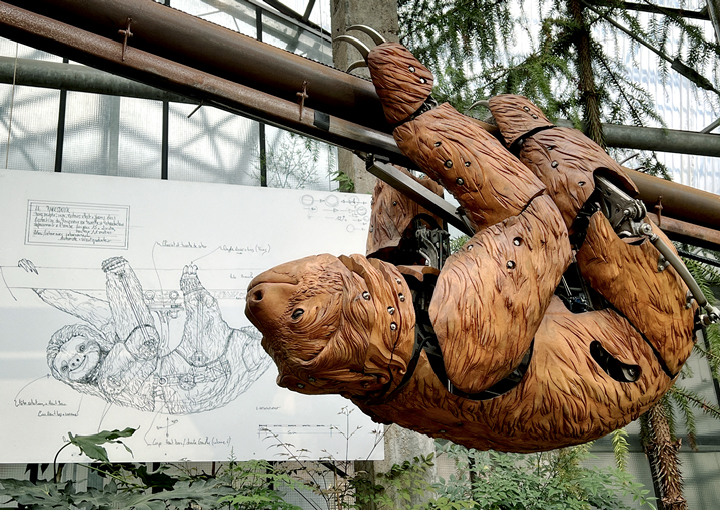

We were grinning like the happiest of children, completely entranced by these wonderful creatures and the charming people who create and demonstrate them. It could only get better with a ride on the elephant, and off we went to climb up on its back. We took a half-hour stroll along the old shipyard, clapping in delight when the elephant would bellow or raise its trunk to spray the onlookers.
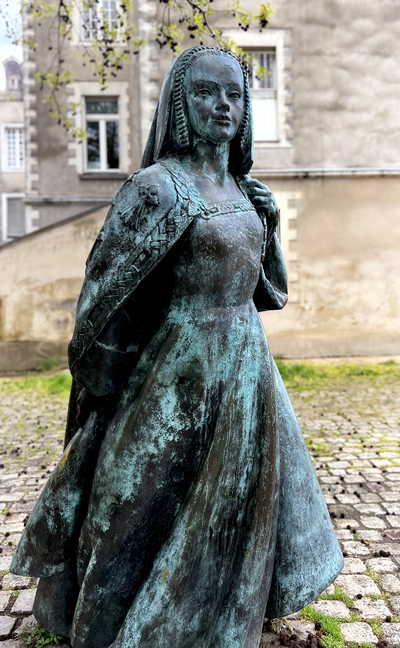
Seen around Nantes
We’d spent the day immersing ourselves into two very different worlds, and we thought it might be nice to have a little rest at our hotel before heading back out to find dinner. But then we walked past an enticing tea house, and decided to look inside.
What we’d stumbled up was La Cigale, an Art Nouveau brasserie dating to 1895. When it opened, it was popular with writers, artists and actors because it’s just across the square from the city’s theater. In the 1960s it became a fast-food restaurant, but the interiors remained intact because they already had protected status as a historic building. It was later abandoned and neglected, until a new owner refurbished it, reopening it as the brasserie/tea house that it is today.
We savored a perfectly delicious hot chocolate while we soaked up the atmosphere. Most of the other patrons seemed to be locals, like grandparents taking grandchildren out for a treat. We enjoyed it so much that we decided to return the next morning for breakfast.


Nantes recap
This was one very quick trip, but it was nearly perfect and we thoroughly enjoyed ourselves. One thing we both noticed was that every single person we interacted with—from the hotel staff to the café owners and their staffs, the people at the history museum and the folks at Les Machines, and the taxi drivers too—every one of those people was warm, welcoming, friendly, helpful, eager to talk with us. In all my travels, I’m sure I’ve never experienced anything like it. Nantes itself is a lovely city, full of history and architecture and the arts. I’d gladly make a return trip, and I wouldn’t say no to another stroll atop a giant elephant.
 Lo Vedo Life
Sounds like such a fun time to share with a friend. Seeing & experiencing the old w the new… quite a juxtaposition. The hot chocolate sounds delicious. That’s my go-to drink at the moment.
LikeLike
Yes, it was nearly mind-bending to look at a 2,000-year-old terra cotta horse in one moment, and then take a ride on a distinctly modern steampunk elephant in the next. But all great fun, and the hot chocolate, well, that’s one of life’s great pleasures! Thanks for writing, Cathy!
LikeLike